
Quality Control Excellence in Automotive Water Pump Manufacturing
Automotive water pumps play a mission-critical role in modern vehicle thermal management systems. A single failure can lead to engine overheating, reduced efficiency, or catastrophic damage. For this reason, quality control in automotive water pump manufacturing is not optional—it is foundational.
This article provides a deep, manufacturing-level view of how quality excellence is achieved in automotive water pump production, covering process control, inspection technologies, material verification, and data-driven manufacturing practices.
Why Quality Control Is Critical in Automotive Water Pump Manufacturing
Unlike many structural automotive components, water pumps operate under continuous thermal cycling, pressure variation, and chemical exposure. This creates a unique risk profile:
- Seal degradation under heat and coolant chemistry
- Bearing wear from axial and radial loads
- Housing deformation due to casting or machining variation
- Flow inefficiency caused by impeller geometry deviation
Effective quality control must therefore address dimensional accuracy, material integrity, functional performance, and long-term reliability—not just appearance or basic fit.
ISO-Aligned Quality Management as the Foundation
A robust quality system in water pump manufacturing is typically built on ISO 9001 principles, ensuring process consistency, traceability, and continuous improvement.
Key implementations include:
- Documented process controls for machining, assembly, and testing
- Defined inspection criteria tied to customer drawings and GD&T
- Corrective and preventive action (CAPA) mechanisms
- Lot-level traceability from raw material to finished pump
This framework ensures quality is engineered into the process—not inspected in at the end.
In automotive applications, quality management systems are often validated against industry-specific standards rather than generic frameworks alone. Our quality processes align with automotive requirements and are supported by our IATF 16949:2016 certification, ensuring consistent process control, traceability, and risk management across production.
End-to-End Quality Control Across the Manufacturing Process
Incoming Quality Control (IQC)
Quality begins before machining starts. Incoming inspections typically focus on:
- Material grade verification (aluminum alloys, cast iron, stainless steel)
- Chemical composition checks using XRF analysis
- Dimensional validation of cast or forged blanks
- Surface integrity and porosity screening
Early detection at IQC prevents costly downstream rework or scrap.
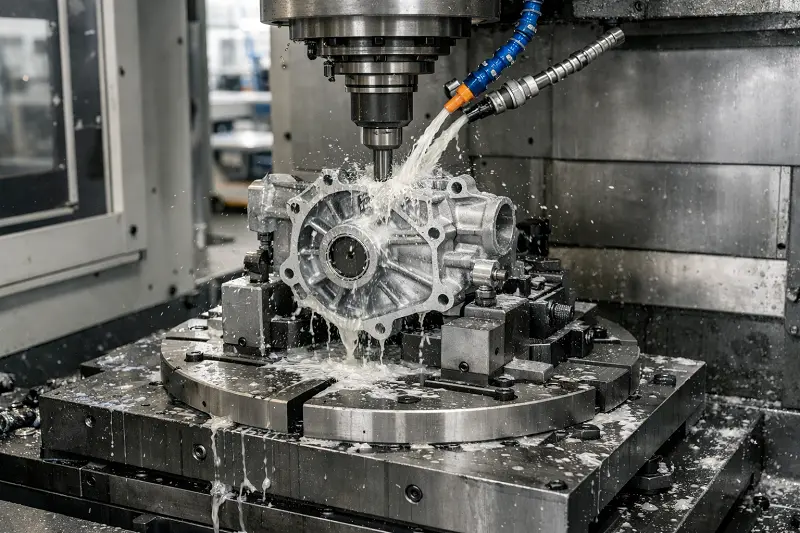
In-Process Quality Control (PQC)
During CNC machining and sub-assembly, process stability is continuously monitored:
- First-article inspection (FAI) for new setups or revisions
- In-process dimensional checks using gauges or probes
- Tool wear monitoring to prevent drift
- SPC tracking of critical dimensions such as shaft bore concentricity
This stage is essential for maintaining consistency in high-volume or repeat production.
Outgoing Quality Control (OQC)
Before shipment, water pumps undergo functional and visual verification, including:
- Leak and pressure testing
- Rotational torque and bearing noise evaluation
- Visual inspection for surface defects or assembly errors
- Packaging inspection to prevent transit damage
Only fully verified units are released for delivery.
Advanced Testing Technologies for Functional Reliability
To meet modern automotive standards, manufacturers increasingly deploy advanced inspection tools:
- CMM (Coordinate Measuring Machines) for high-precision geometry validation
- Automated leak testing systems using air or vacuum methods
- Flow and pressure performance testing under simulated operating conditions
- NVH (noise, vibration, harshness) testing for bearing and impeller behavior
These methods validate not only dimensional accuracy but real-world functional performance.
Smart Manufacturing and Data-Driven Quality Control
Leading manufacturers now integrate Industry 4.0 concepts into water pump quality control:
- IoT sensors monitoring temperature, vibration, and process parameters
- Real-time dashboards for quality and equipment health
- AI-assisted defect detection in visual inspection
- Predictive maintenance to reduce unplanned downtime
Data-driven quality systems enable early anomaly detection, reducing both defect rates and production interruptions.
Material Verification and Full Traceability
Material integrity directly impacts pump lifespan. Effective quality systems ensure:
- Batch-level material traceability
- Correlation between material certificates and production lots
- Controlled storage and handling to prevent contamination
- Clear documentation for automotive audits and PPAP requirements
This traceability is critical for both OEM supply chains and aftermarket compliance.
Continuous Improvement and Risk Reduction
Quality excellence is not static. Continuous improvement programs focus on:
- Root cause analysis of defects and field returns
- Process optimization based on SPC trends
- Design for manufacturability (DFM) feedback loops
- Cross-functional collaboration between engineering, quality, and production teams
These practices reduce long-term risk while improving yield and consistency.
In automotive manufacturing, quality control is most effective when supported by a structured quality assurance framework. A broader overview of how quality assurance systems are applied in precision manufacturing can be found in our quality assurance overview, which explains how process control, inspection, and continuous improvement work together.
Choosing a Manufacturing Partner with Proven Quality Control
When sourcing automotive water pumps or precision pump components, buyers should evaluate:
- Depth of quality management systems
- Inspection and testing capabilities
- Experience with automotive tolerances and standards
- Ability to provide documentation, traceability, and engineering support
A supplier’s quality system often matters more than unit price when lifecycle cost and reliability are considered.
Conclusion
Quality control excellence in automotive water pump manufacturing is achieved through structured systems, advanced inspection technologies, smart data integration, and continuous improvement. By embedding quality into every stage—from material intake to final testing—manufacturers can deliver pumps that meet stringent automotive performance and reliability demands.
For projects requiring automotive-grade quality control and precision manufacturing, our team can provide technical support and production insight. Contact us to discuss your application.
Key Takeaways
- Choose the manufacturing process based on tolerance, material, load, surface finish and validation stage.
- For automotive prototypes, CNC machining is usually preferred when precision, repeatability and real engineering materials matter.
- A reliable supplier should support DFM review, inspection reporting, finishing, small-batch production and fast quoting.